
Building Rapport with Guests Key to Success in Tasting Room Sales

Check out this article about wineries curating the guest experience to help boost sales.
Full Article: Building Rapport with Guests Key to Success in Tasting Room Sales
Check out this article about wineries curating the guest experience to help boost sales.
Full Article: Building Rapport with Guests Key to Success in Tasting Room Sales

Tariffs continue to impact the cost structure and profitability of businesses across both the U.S. and Canada. With the right strategies, you can reduce exposure, maintain competitiveness, and protect your bottom line.
Watch Schooley Mitchell’s free, value-packed webinar where we’ll break down:
Who Should Watch: Business owners, CFOs, operations managers, procurement professionals, and decision-makers concerned with cost management and global trade.

The National Motor Freight Classification system has made some updates on how it classifies less-than-truckload (LTL) shipping. The changes go into effect on July 19th. If your business or organization uses LTL services to move your product, here’s what you need to know about these new classifications.
The National Motor Freight Traffic Association (NMFTA) is a nonprofit membership organization and the world’s leading organization representing the interests of LTL carriers. The association’s membership is comprised of motor carriers operating in interstate, intrastate, and foreign commerce. Meaning, their membership may include your LTL vendor. Therefore, their new classifications could impact your services.
Industry experts are expecting the NMFTA’s changes “to streamline classifying LTL Freight.” Its classification system – The National Motor Freight Classification (NMFC) – has been critiqued in the past for being very confusing, and the aim is to simplify it. Its goals are to:
This will be accomplished by introducing:
If you’re not sure what any of this means, that’s okay. Industry jargon can be hard to understand from the outside. But if your business uses LTL for operations, here are the important things to keep in mind. NMFTA says that, for shippers, “identifying your freight class will be easier, but you may need to provide handling unit dimensions and weight.”
Meaning, that in the long run, this should make your life easier, however, if you fail to be proactive about the new classification systems, it may result in misclassified shipments, which could then cause unexpected charges, delays, and disputes. These changes are being implemented July 19th, so theoretically, charges and delays could begin as soon as then if you don’t take the time to review the new classifications and ensure all your shipments are in order. It’s also a good idea to contact your provider and ensure all the classifications and changes are made on their end as well.
If your company uses LTL providers that operate in the United States, NMFTA recommends reviewing all the changes on their bulletin, found here.
Proactivity is key. If you’re a business that ships products with LTL providers, be aware of the new classification changes, and ensure you’re not accidentally misclassifying your goods come July 19th.


Looking for a martial arts-focused gym that boosts your confidence? Check out One Tribe Combat Training Collective, where fitness and community are at the heart of everything. No matter your skill level, its expert trainers are here to help you build confidence and provide the best training experience for all ages.

To whom it may concern,
I am writing to highly recommend Interweave Technologies, a distinguished IT management company based in Huntsville, Alabama. Since its inception in 2005, Interweave Technologies has established itself for providing reliable and innovative technology solutions.
Interweave Technologies specializes in a wide array of services, including IT infrastructure management, network security, cybersecurity protection, and all-in-one technology support, all designed to help businesses optimize their technological environments. It takes a client-centric approach, ensuring that businesses receive comprehensive, scalable solutions that enhance efficiency and productivity.
The team at Interweave Technologies is another key strength of the company. Composed of highly skilled and dedicated professionals, they work collaboratively to provide top-tier service and support. Their commitment to customer satisfaction and proactive approach to problem-solving is evident in the long-term relationships they build with their clients.
I wholeheartedly recommend Interweave Technologies to any organization in need of IT management services. Its expertise, dedication, and exceptional service makes it a standout choice for any technological need.
Sincerely,
Jason Fish
Strategic-Partner
Schooley Mitchell
Product returns are always an unhappy expense to a business. But if that involves paying for a customer to ship the product back to you, that expense is amplified. Amid rising expenses, including climbing shipping rates, many businesses are looking to combat budget constraints by tackling return rates. In this article, we take a look at this predicament, and what can be done to avoid your shipped goods being sent back to you.
How much of an issue are return shipments?
In 2024, the average return rate for ecommerce was 16.9% of sales – though some retailers are looking at numbers closer to 30%, depending on the product. Clothing and shoes, as well as other items requiring specific sizing, are often returned at higher rates. This number is also climbing, more than doubling from an average of 8.1% in 2019.
That’s a pretty staggering number, when you picture between 17 and 30 of every 100 e-commerce purchases being returned. Then, imagine the shipping costs and other expenses associated with that rate. In 2024, consumer returned products cost American businesses $890 billion. On average, the cost to process a return can be anywhere from 20%–65% of the item’s original value.
Trends show brands are changing their return policies.
The Reverse Logistics Association’s (RLA) returns index for 2024 found that major brands are strategizing against cost increases by addressing return policies. Among a selection of American top hundred retailers:
Likewise, a different study by ReturnPro found that “that nearly 60% of retailers have keep-it policies for items that aren’t financially viable to ship back.”
This isn’t only because of rising costs. The rise of fraudulent returns is also on the rise, causing a “significant issue” for as much as 93% of retailers. Protecting yourself against this expense is an important part of your logistics and fulfillment strategy.
How do you reduce your business’ return rates?
Charging for certain returns or having no-return policies on some items are some of the strategies businesses are using to reduce return rates. Some practices you may want to implement, if possible, include:
Of course, returns will never entirely disappear. Mistakes happen, both on the seller and buyer’s ends. However, there are steps that can be taken to reduce your rates, beating the 17 in 100 statistic.

I’m thrilled to share the incredible success of the Better Business Bureau of North Alabama’s recent Shred Day!♻️ As a proud volunteer, I was honored to support our community in this impactful event. Together, we safely shredded thousands of pounds of sensitive documents and responsibly disposed of harmful waste, protecting identities and the environment. The turnout was amazing, and seeing everyone come together to promote safety and sustainability was truly inspiring! Huge thanks to the BBB team, fellow volunteers, and all who participated. Let’s keep making a positive difference!

Check out my latest feature on Beyond Rockets podcast where I speak with Clark Dunn and discuss how you can save on your business expenses with Schooley Mitchell. You don’t pay unless we find you savings.

Last week I attended the 2025 AUSA Global Force Symposium & Exposition.
The 2025 AUSA Global Force Symposium & Exposition explored the U.S. Army’s modernization strategy by fostering collaboration between military and industry leaders to drive transformational change and showcase cutting-edge technology. Key areas of focus included AI, cybersecurity, and advanced communication systems.
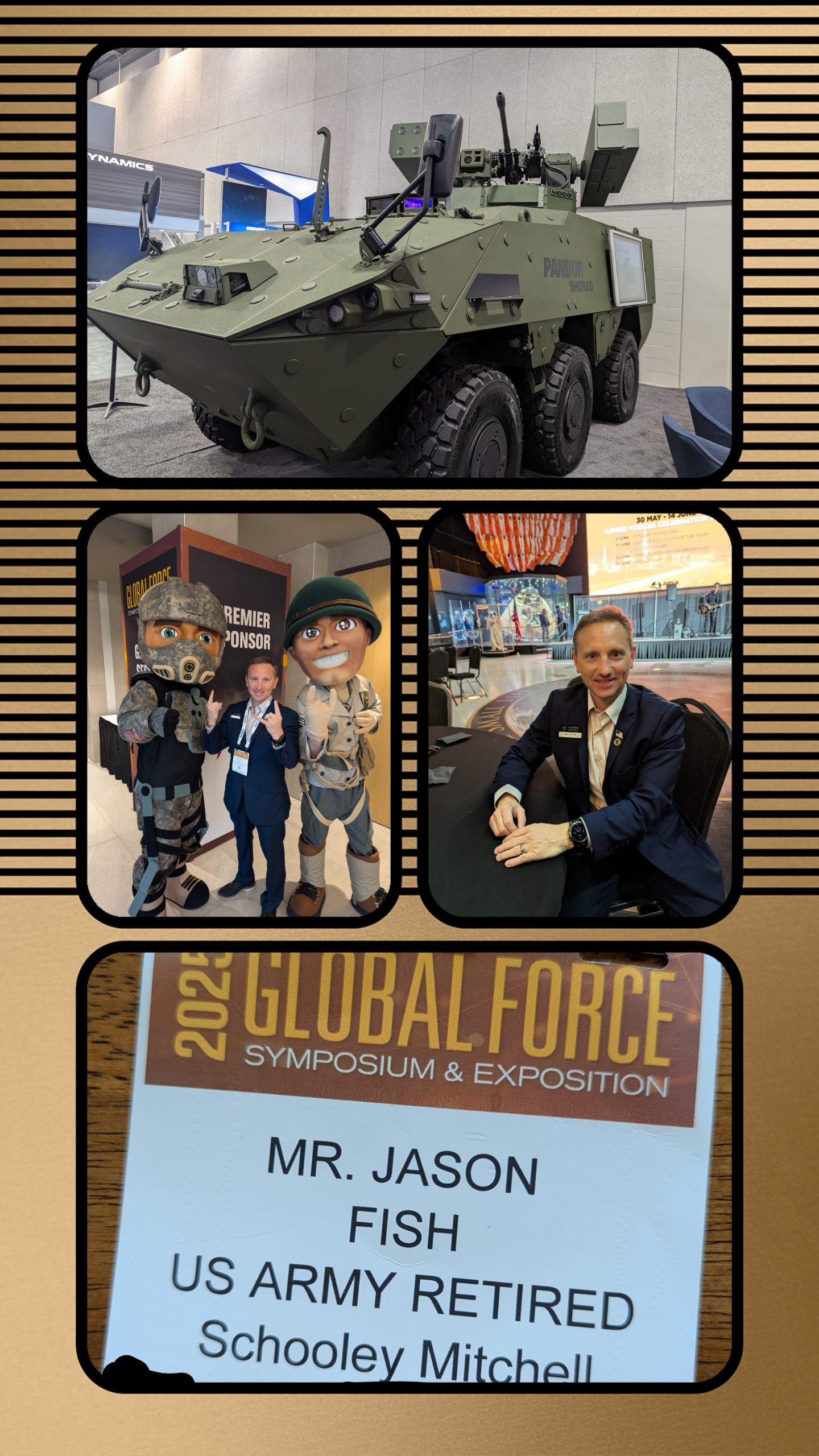
Key Objectives:
Focus on Army Modernization: The event centered around the Army’s efforts to modernize and evolve into a multi-domain capable force.
Collaboration and Knowledge Exchange: It served as a platform for senior military leaders, defense industry professionals, and key stakeholders to connect, share insights, and discuss critical topics like research and development, acquisition, and force sustainment.
Showcasing Technology: Attendees had the opportunity to see and discuss emerging technologies, including artificial intelligence, cybersecurity, robotics, and advanced communication systems.
Driving Transformational Change: The symposium fostered collaboration and drove change within the defense industrial base, ensuring the Army could conduct multi-domain operations (MDO).
Focus on the Future: The event examined the Army’s modernization strategy with an emphasis on maintaining an over-match in the context of great power competition.
This symposium played a pivotal role in shaping the future of the Army and its relationship with the defense industrial base.
What a great networking and educational experience. I am already looking forward to next year’s event.

Interweave Technologies, based in Huntsville, Alabama, has been a trusted provider of innovative IT solutions since 2005. It helps to protect your business with comprehensive managed IT services that combine world-class security, compliance, and support.