John Rumasuglia / December 1, 2025

Unlocking Hidden Value in the Wood River Valley Economy
Businesses across the Wood River Valley continue to face rising costs, tighter margins, and increasing pressure to operate efficiently. A recent analysis of indirect business expenses across key local industries highlights a significant opportunity: many organizations are spending more than they need to on everyday services.

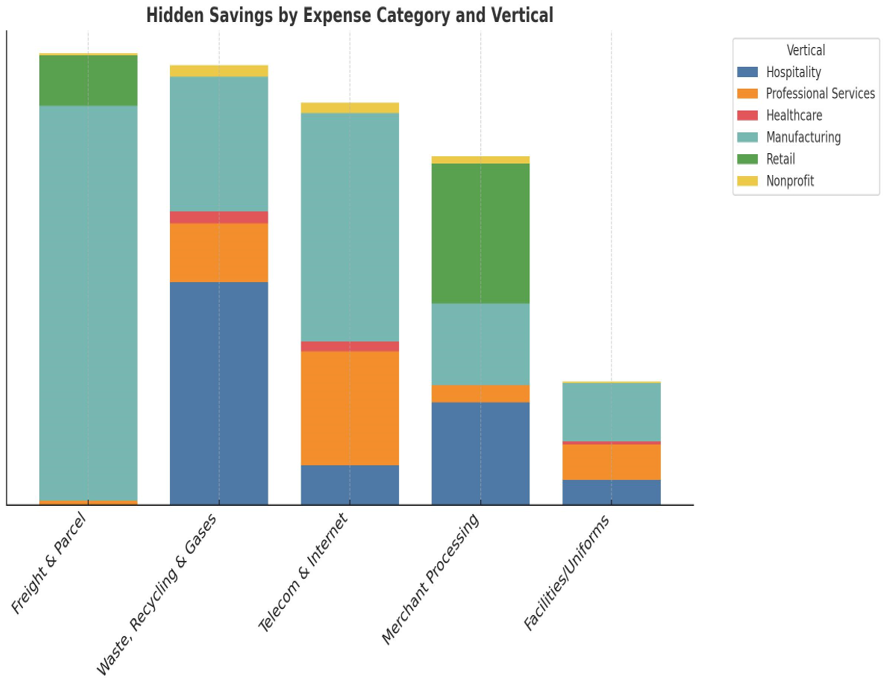
Across six sectors — hospitality, professional services, healthcare, manufacturing, retail, and nonprofits — Wood River Valley organizations collectively spend just over $300 million each year on indirect services. These include telecom and internet, freight and parcel, software, merchant processing, waste and recycling, fleet fuel, and facilities-related costs.

Using conservative savings rates tailored to each industry and category, the analysis indicates that local organizations are overspending by an estimated: ≈ $73 million every year.

These dollars represent avoidable costs — often caused by outdated contracts, billing errors, rate drift, unused services, or fees that no longer match business activity.

The Chamber recently emphasized:

“When you shop local, 68% of money spent stays in the local economy.”

The same principle applies to recovered dollars.
When local businesses reduce unnecessary spending, those funds don’t disappear — they stay here, supporting jobs, wages, equipment upgrades, technology adoption, inventory growth, and nonprofit programming.

Where the Overspend Occurs

The largest modeled opportunities are in:

  • Waste & Recycling: ~$21M
  • Freight & Parcel: ~$14.7M
  • Telecom & Internet: ~$14.0M
  • Merchant Processing: ~$10.7M
  • Facilities & Uniforms: ~$6.2M
  • SaaS & IT: ~$4.3M
  • Fuel & Fleet Cards: ~$2.1M

These are ordinary operational costs that often drift over time without regular review. Even modest improvements can create meaningful impact because these services bill monthly and compound year after year.

Why This Matters to the Community

Every dollar that stays in the Wood River Valley strengthens the local economy.
Because many organizations operate without procurement teams or category specialists, managing these expenses can be challenging. Over time, this leads to unintended overspending — and lost opportunity.

By improving visibility into common service categories, local businesses can free up resources to:

  • Hire seasonal and full-time staff
  • Strengthen wages
  • Reinvest in automation and technology
  • Expand inventory during peak periods
  • Enhance non-profit mission delivery
  • Weather seasonal fluctuations with more stability

This isn’t cost-cutting for its own sake.

If you’d like to set up a snapshot or ask questions, I’d be happy to help.

John Rumasuglia works with Schooley Mitchell to help Idaho businesses improve margins and free up resources for growth. From Hailey, he supports manufacturers, nonprofits, and service providers across the Wood River Valley. More information is available at www.schooleymitchell.com/jrumasuglia

 

Ian Nairn / November 14, 2025

Building a Simple Continuous Improvement System for Wood River Valley Businesses

Running a business in the Wood River Valley is deeply rewarding — but it often comes with rising operating costs, seasonal rhythms, limited staffing, and the constant challenge of managing vendors, subscriptions, and service contracts.

In my work representing Schooley Mitchell of Idaho, helping local organizations review telecom, software, merchant services, waste contracts, freight, and other recurring expenses, I see a consistent pattern:

Most businesses are paying more than they need to — often by 10–30% — without realizing it.

Not because anyone is careless, but because small fees, outdated plans, and automatic renewals slip by unnoticed.

The good news is that a simple Continuous Improvement System (CIS) can give businesses clearer control over their spending without adding complexity or workload. It’s a structure I use with Schooley Mitchell clients across Idaho, and it works for organizations of every size and industry.

Here’s how any local business can start.

1. Gather all recurring costs in one place

Telecom, internet, software subscriptions, merchant services, shipping, waste, and utilities are often scattered across people and departments.

In nearly every Schooley Mitchell engagement I’ve done locally, simply compiling this list reveals hidden charges or outdated services.

2. Review these costs once every quarter

A 90-day rhythm keeps costs from drifting.
During each review:

  • Check for new fees
  • Compare usage to what you’re paying for
  • Confirm pricing is still competitive
  • Flag contracts that are set to auto-renew

This is the same cadence Schooley Mitchell uses when monitoring client accounts — it prevents surprises and keeps spending aligned with current needs.

3. Assign an owner for each category

Even small teams can benefit from clear responsibility.

One person watching subscriptions, another watching telecom, someone else watching waste or merchant services.

When nobody is assigned, costs drift.

When someone is assigned, even lightly, waste drops fast.

4. Keep a one-page dashboard

A CIS doesn’t require software.
A simple dashboard works:

  • Vendors
  • Costs
  • Renewal dates
  • Notes
  • Owner
  • Status

It’s the same type of dashboard I maintain for Schooley Mitchell clients — clean, simple, and actionable.

5. Focus on the categories where drift is most common

Across the Valley, I consistently find overspending in:

  • Telecom & internet (old plans, outdated pricing)
  • Software & subscriptions (unused seats, duplicate tools)
  • Credit card processing (quiet fee changes)
  • Waste & recycling (misaligned service levels)
  • Shipping & delivery (paying for unnecessary speed or surcharges)

These are Schooley Mitchell’s core specialty areas — and also where local businesses tend to see the fastest improvements.

6. Reinvest savings into what matters most

A healthy CIS isn’t about cutting — it’s about redirecting resources where they make a real difference:

  • Staff development and retention
  • Technology upgrades
  • Improving customer experience
  • Seasonal staffing
  • Expanding nonprofit programs
  • Facility repairs or modernization

When organizations free up dollars they’ve been overspending on vendor services, that money stays in the Valley — supporting jobs, stability, and community vitality.

Why this matters for the Wood River Valley

A stronger, more efficient local business community benefits all of us:

  • More stable jobs
  • Healthier nonprofits
  • Better customer experiences
  • Stronger local hiring
  • A more resilient economy

Every dollar saved from unnecessary vendor waste is a dollar that stays right here in our Valley.

Complimentary Savings & Improvement Snapshot

As the local Schooley Mitchell consultant serving the Wood River Valley, I offer a complimentary Savings & Improvement Snapshot to help organizations identify where costs may be drifting.

This includes:

  • A quick review of your recurring vendor expenses
  • Insight into whether your pricing is competitive
  • Identification of hidden fees or outdated services
  • Simple steps to implement your own Continuous Improvement System
  • Optional ongoing monitoring if you want a partner to manage it

This service is free, fast, and designed to support our local business community.

If you’d like to set up a snapshot or ask questions, I’d be happy to help.

John Rumasuglia works with Schooley Mitchell to help Idaho businesses improve margins and free up resources for growth. From Hailey, he supports manufacturers, nonprofits, and service providers across the Wood River Valley. More information is available at www.schooleymitchell.com/jrumasuglia


John Rumasuglia / October 30, 2025

Expense Category Deep Dive — Waste, Telecom, and Freight

Not every dollar that leaves your business adds value.
In fact, many local companies quietly lose thousands each year in everyday service categories that rarely get reviewed — waste disposal, telecom, and freight.

These aren’t glamorous areas, but they often hold the most practical savings opportunities for Wood River Valley businesses working to stay competitive and community-minded.

Waste & Recycling

Landfill fees, recycling surcharges, and container charges have crept up steadily in recent years.
It’s common for businesses to be billed for service levels that no longer match their current volume — or to miss credits they’re owed for recycling offsets.

  • Review service frequency and container size
  • Ask about recycling rebate programs
  • Verify fuel and environmental surcharges

“Even small billing errors can add up to big annual savings.”

Typical Results: 10–25 % annual savings without changing vendors

Case Snapshot:
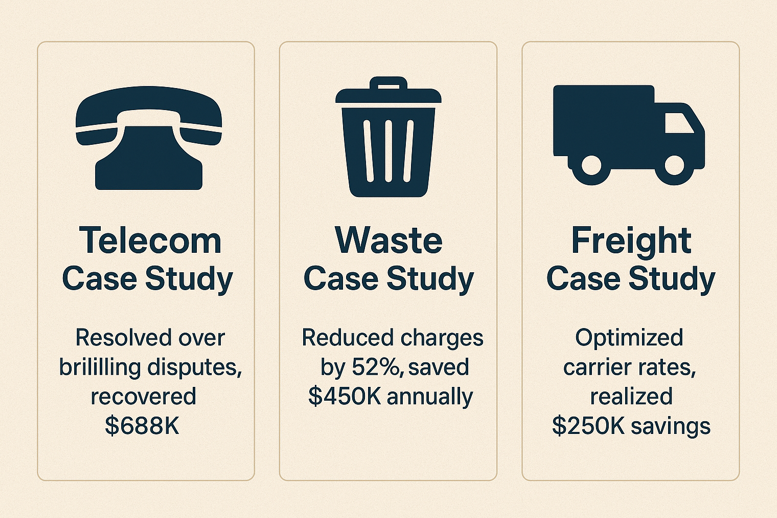
A regional manufacturer discovered $14,000 in annual overcharges after a simple service-level reconciliation.

Telecom & Internet

Telecom invoices are full of complexity — and, as national studies show, most billing errors favor the carrier.

Even here in the Valley, many small firms still pay for unused lines, legacy data plans, or double-billed services.

  • Audit monthly statements against current use
  • Retire unused numbers or plans
  • Compare market rates for similar bandwidth

“Telecom costs rarely go down on their own — but they can, once you know what to look for.”

Typical Results: 15–30 % savings through simple plan realignment

Case Snapshot:
A local food processor reduced monthly wireless costs by $2,400 by eliminating redundant data plans and securing missing credits.

Freight & Shipping

Shipping and logistics costs often fly under the radar. Small shifts in rates, zones, or carriers can quietly add up.

  • Check for unclaimed delivery refunds
  • Balance parcel vs. LTL freight for efficiency
  • Review carrier accessorial fees annually

“Every shipment is a small opportunity to protect your margin.”

Typical Results: 8–15 % improvement through contract and mode optimization

Case Snapshot:
A consumer goods company uncovered $27,000 in refund-eligible shipments by auditing delivery guarantees and rebalancing carriers.

Local Perspective

Across dozens of Idaho businesses, the pattern is consistent:
Most savings don’t require switching vendors — just paying attention to where value slips away.

In a community where every business dollar supports local jobs and growth, recovering that hidden 10–30 % can make a real difference.

Next in the Series

Article 5 — How to Build a System for Ongoing Expense Reduction

John Rumasuglia works with Schooley Mitchell to help Idaho businesses improve margins and free up resources for growth. From Hailey, he supports manufacturers, nonprofits, and service providers across the Wood River Valley. More information is available at www.schooleymitchell.com/jrumasuglia
 

John Rumasuglia / October 17, 2025

The 3 Levers for Cost Reduction Success

Most cost-cutting efforts fall flat because they focus only on price. Sustainable savings come from a more strategic approach — one rooted in transparency, alignment, and control.

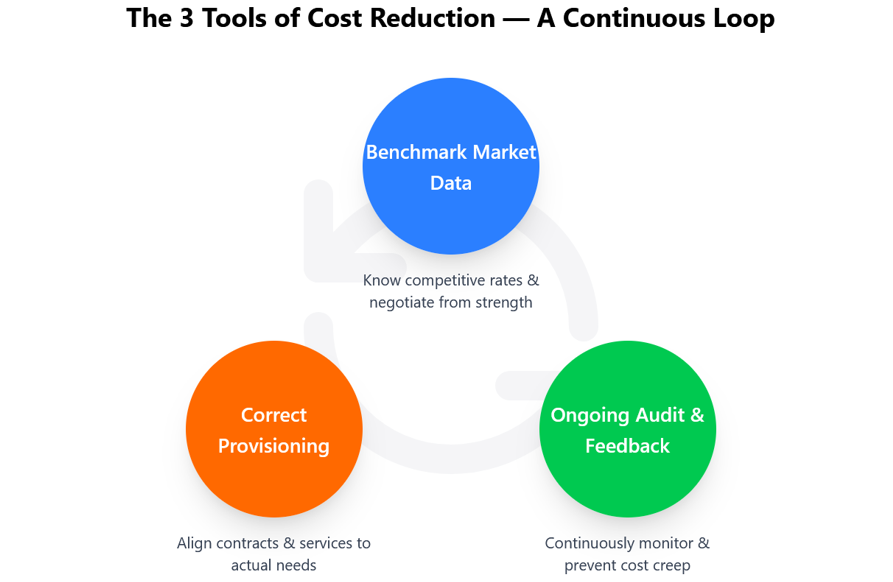
At Schooley Mitchell, we’ve found that three disciplines consistently separate short-term cuts from lasting results.

  1. Benchmark Market Data
    You can’t negotiate what you don’t understand. Without market visibility, you’re negotiating in the dark.
    Whether it’s telecom, SaaS, shipping, or merchant services, knowing what others pay for the same level of service turns guesswork into leverage.
  2. Right-Size Features and Usage
    Even with competitive pricing, many companies overpay because their service mix doesn’t match actual needs.
    Real savings come from aligning features, usage, and fit — trimming what’s unused, consolidating what’s redundant, and matching service levels to real demand.
  3. Audit Continuously
    Costs drift. Vendors change rates, billing errors creep in, and usage evolves.
    A one-time savings project won’t hold.
    Routine audits and feedback loops are what keep savings real — month after month.

The Hidden Opportunity

Most organizations believe they’ve already “cut the fat.”
Yet we routinely uncover 5–25% in additional savings across categories like freight, telecom, merchant processing, waste, and software — often without switching providers or disrupting operations.

The Bottom Line

You don’t need a massive consulting engagement to find hidden savings.
You just need a partner who knows where to look.
Curious what’s hiding in your contracts?
I’d be glad to share a few examples — just ask.

John Rumasuglia works with Schooley Mitchell to help Idaho businesses improve margins and free up resources for growth. From Hailey, he supports manufacturers, nonprofits, and service providers across the Wood River Valley. More information is available at www.schooleymitchell.com/jrumasuglia


John Rumasuglia / October 2, 2025

How Idaho Businesses Are Unlocking an Average of 28% in Hidden Savings

Most businesses assume their everyday expenses are under control. But our data—and thousands of audits—tell a different story.

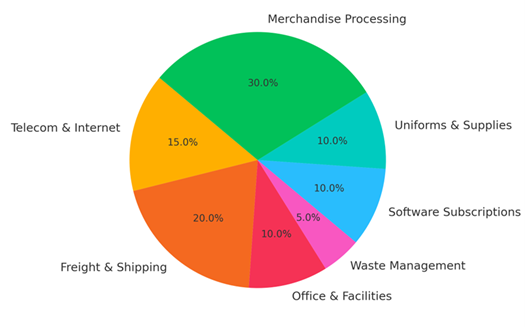
📊 The graphic right shows how indirect expenses typically break down for small and mid-sized businesses. Across these categories, we consistently find that companies are paying 20–40% more than they should. On average, that adds up to 30% in unnecessary spend.

Where the overspending hides:

  • Telecom & data – outdated plans, unnecessary surcharges
  • Software/SaaS – unused licenses, overprovisioned seats
  • Shipping & freight – dimensional weight errors, missed refunds, incorrect accessorial fees
  • Merchant services – complex rate structures that favor the processor
  • Waste & recycling – inefficient pickups or underutilized contracts

Most of this spend never gets reviewed. And since these aren’t “headline” expenses, they often escape executive attention.

But the upside? This is found money. Fixing it doesn’t require hiring, rebranding, or massive change management. Just the right data and oversight.

John Rumasuglia works with Schooley Mitchell to help Idaho businesses improve margins and free up resources for growth. From Hailey, he supports manufacturers, nonprofits, and service providers across the Wood River Valley. More information is available at www.schooleymitchell.com/jrumasuglia

John Rumasuglia / September 18, 2025

Unlocking Hidden Profits in the Wood River Valley

Unlocking Hidden Profits in the Wood River Valley

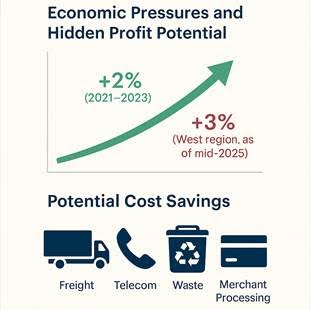
In the Wood River Valley, it’s not uncommon to hear business owners talk about the squeeze they’re feeling. Freight & utility costs are higher than expected, telecom bills seem to grow without explanation, and everyday services keep creeping up in price. Even as companies work hard to grow revenue, inflation and rising operating costs often eat away at margins.

What many don’t realize is that a significant share of these pressures comes from hidden inefficiencies in indirect expenses — categories like shipping, merchant processing, and waste services. These costs rarely get the same scrutiny as payroll or raw materials, yet they can quietly drain thousands of dollars from the bottom line each year.

The Overlooked Opportunity

When leaders think about cost reduction, their attention usually goes to big-ticket items: payroll, raw materials, or customer pricing. But indirect expenses typically account for 15–25% of a company’s spend. These areas are riddled with billing errors, inflated rate structures, and misaligned service levels.

In other words, the very services businesses depend on to run day-to-day are often overpriced without anyone noticing.

What the Data Shows in Blaine County

Research highlights just how widespread the problem is:

  • Rising construction costs pushing up overhead.
  • Inflationary pressures on supplies and services.
  • Flat sales growth, despite regional demand.
  • Low unemployment, making talent harder — and more expensive — to secure.

Together, these factors squeeze margins thinner and make cost efficiency more critical than ever.

Three Levers for Unlocking Savings

At Schooley Mitchell, we focus on three proven levers to uncover hidden profit:

  1. Vendor Error Recovery – catching and correcting billing mistakes that favor the vendor.
  2. Rate Optimization – benchmarking contracts against real-world market rates.
  3. Usage Alignment – ensuring companies pay only for the services they actually need.

Across thousands of projects, applying these levers consistently delivers 10–40% savings in indirect expense categories — savings that most companies never realized were possible.

Fuel for Growth

This isn’t about “cutting to the bone.” It’s about uncovering dollars that are already leaving your business unnecessarily and redirecting them into strategic priorities — new equipment, technology upgrades, additional staff, or community investment.

In a region like the Wood River Valley, where local businesses play such a vital role in the economy, unlocking these hidden savings can be the difference between standing still and moving forward.

John Rumasuglia works with Schooley Mitchell to help Idaho businesses improve margins and free up resources for growth. From Hailey, he supports manufacturers, nonprofits, and service providers across the Wood River Valley. More information is available at www.schooleymitchell.com/jrumasuglia