Senior living operators: manage the costs you can control
 Whether the goal is profitability or simply preserving the resources needed to fulfill a mission, senior living communities across the United States are challenged with rising costs and they’re having to work harder than ever to protect their financial sustainability.
Labor’s in the spotlight, what’s in the shadows?
Labor dominates the conversation for good reason, but non-labor operating expenses may be quietly draining your operating budget. Categories like supplies, uniforms and linens, waste removal, and telecom tend to stay on autopilot; invoices get paid, contracts renew, and pricing drifts upward without anyone noticing or knowing what alternatives are available.
Individually, these categories may not be substantial, but collectively, they can have a significant impact on your community’s financial performance.
For those who have already taken steps to address costs, it’s worth asking whether those efforts have produced the best possible financial outcome, or simply a better number than what came before. There’s a meaningful difference between improved and optimal, and in many cases, significant savings are still being left on the table.
Bandwidth is a challenge
With leadership rightfully focused on residents, staffing, and compliance, senior living operators often don’t have the bandwidth left to review these expenses, nor do they have the subject matter experts required to secure the best rates and terms for the wide variety of operating costs. This is true whether an organization is for-profit or mission driven. The result in either case is that cost decisions get made and then inertia, rather than analytics, starts to run the vendor relationship.
Operators are best served by developing a means to off-load the time-consuming data collection and aggregation work, with leadership only reengaging to review findings and render informed go/no-go decisions.
Multi-location operators fail to flex
Scale should create purchasing leverage. In practice, it often doesn’t.
Communities acquired or merged into a larger portfolio typically bring their own vendor relationships with them. The result is often a patchwork of independently negotiated contracts and suppliers with different renewal dates and pricing terms.
The consolidated organization is paying for volume it should be getting credit for, but the time associated with collecting and then vetting all the various agreements and pricing structures deprioritizes the matter and the budget drain cycle continues.
Consolidating your vendors is one of the most consistent and significant opportunities available for growing operators.
A process built around your interests
At Schooley Mitchell, we take the time-consuming data collection and analytical work off our clients’ plates and shift it to ours. Before any conversation about pricing takes place, our category subject experts establish a baseline of your current cost structure. Then, we conduct an analysis to see if you’re overspending, and if cost-saving solutions can be found – examining existing invoices for proper provisioning, billing accuracy, rate drift, and traditionally supplier-friendly auto-renew and auto-escalation clauses. The findings from that audit alone frequently surface savings before a single pricing structure changes.
From there, we design and conduct a custom procurement exercise built around the specific needs and circumstances of that client. There are no pre-negotiated contracts or predetermined outcomes. Similarly, there is no fixed portfolio of suppliers that we work with. We receive no financial incentives from the vendors we recommend, so every value report is objective and grounded in what is truly best for that specific client.
We do this work at our own cost and deliver the findings for the client’s consideration. If they elect to implement our recommendations, we share in a portion of the savings realized, meaning they are always financially ahead. If we find no savings, there is no fee and what we deliver instead is something equally valuable: independent confirmation that their current pricing has been validated against the market.
Once the changes have been implemented, we stay engaged. We monitor invoices throughout the term, compare actual billing against agreed-upon terms, flag/resolve discrepancies as they arise, and monitor for material changes in our client’s business while consistently keeping clients informed without adding to their workload.
The Bottom Line
Not every cost driver facing senior living operators today is within their control, but non-labor operating expenses are and they’re worth a harder look than many operators give them. For for-profit operators, that means stronger margins. For non-profit organizations, it means more resources directed where they matter most – toward residents and the mission. In either case, the goal is the same: making sure that every dollar being spent is a dollar well spent.
Contact us today to discuss how Schooley Mitchell can help maximize your operating budget without pulling your attention away from higher priorities.
Russ Ferguson: 203-993-6637
Luca Servino: 203-693-9196
Email: [email protected]

 Lizzabeth Ponce recently received third place for Best Business Services/Small Business Support at West Austin Chamber of Commerce’s 2026 Best of West Austin Awards.
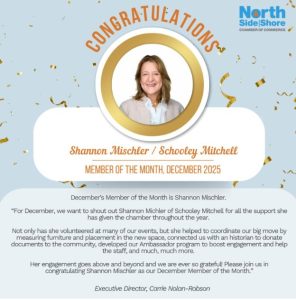 Shannon Mischler was recently named Northside North Shore Chamber of Commerce’s Member of the Month for all the support she has given the chamber throughout the year.
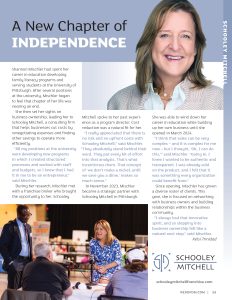 Shannon Mischler was featured in Franchise Dictionary Magazine’s October 2025 issue where she discussed her “new chapter of independence. To read the full article, click
 In December 2025, Shannon Mischler graduated from the University of Pittsburgh’s six month Community Power to Prosper Program for small business owners. She was also invited to join (with a full scholarship) the 2026 Entrepreneurial Fellows Class, a 1-year certificate program preparing business leaders for enhanced company success.