Stacey Shackleton / August 18, 2026

Duke Discoveries: seeing diets through wastewater, regrowing blood vessels, heat alerts, and more

Duke Discoveries: seeing diets through wastewater, regrowing blood vessels, heat alerts, and more

Duke University

August 18, 2026

Welcome to the inaugural edition of Duke Discoveries, a newsletter showcasing research from across Duke University!

This monthly offering will inform you about the cutting-edge science and scholarship happening across Duke – and introduce you to the innovators behind the work. Each issue will come in parts as we experiment with formats. The issues will be based loosely around a theme to capture the incredible discoveries being made, beginning with “Research in Our Backyard.” This is Part 1, come back for Part 2 next week!

From a new way of quantifying diets to keeping communities safe during heat waves, Duke researchers don’t need to venture far to blend expertise with impact – all for the benefit of communities near and far. Join us on the journey, and please feel free to engage and ask questions!

Fedor Kossakovski, Director of Research Communications for Duke University

Remember how North Carolina – and places around the world – began sampling wastewater to track COVID outbreaks? Well, that infrastructure is still being used for public health monitoring of infectious diseases. What else can it be used for?

Lawrence David, a Duke University School of Medicine researcher, recently published a study in PNAS with colleagues from Duke, UNC and Virginia Tech that used this same wastewater sampling setup to mine for genetic signatures of food.

The team developed a new technique dubbed FoodSeq-FLOW, a DNA-sequencing platform attuned to plant and animal DNA, deploying it on wastewater samples from across the state. Some interesting findings include beer hops correlating with wealthier neighborhoods and specific species of fish linked to coastal regions.

Tracking nutrition and diet is notoriously tricky, often relying on self-reported surveys. Wastewater sampling can provide a new tool for researchers and policymakers to discuss food consumption with quantitative data.

There’s interest in this tech locally. David and the team have started a partnership with Durham’s Hayti neighborhood – which is looking for ways to show changes in community nutrition as they work to bring a Black-owned full-service grocery store to the area.

Read more about this research on the School of Medicine website and in The New York Times.

Sharon Gerecht and her lab at Duke University Pratt School of Engineering used induced pluripotent stem cells to rebuild specialized retinal blood vessel cells in mice. This work provides a path to new treatments for various eye diseases. Read more from Pratt – original paper in Nature Biomedical Engineering.

Jin Bai and Lydia Olander at the Nicholas Institute for Energy, Environment & Sustainability were part of a project helping the NC Wildlife Resources Commission assess streams in western North Carolina impacted by Hurricane Helene. Read more from Bai on how this work can help protect Eastern Hellbenders.

Daniel D. Richter and his lab at the Duke University Nicholas School of the Environment led a study characterizing toxic metals left behind in Los Angeles neighborhoods after the 2025 Palisades and Eaton fires. The study offers insights on the effectiveness of post-fire cleanup efforts. Read more from Nicholas – original paper in Environmental Science & Technology Letters.

Nobel Laureate Robert Lefkowitz and his lab at the Duke University School of Medicine have, for the first time, managed to chemically control β-arrestins – important signaling proteins found throughout bodily systems. Read more from School of Medicine – original paper in Nature.

Anna P. Smith, Ph.D. and her advisors at the Duke Trinity College of Arts & Sciences investigated how memory enhances viewers’ appreciation of abstract art. Read more from Trinity – original paper in Memory & Cognition.

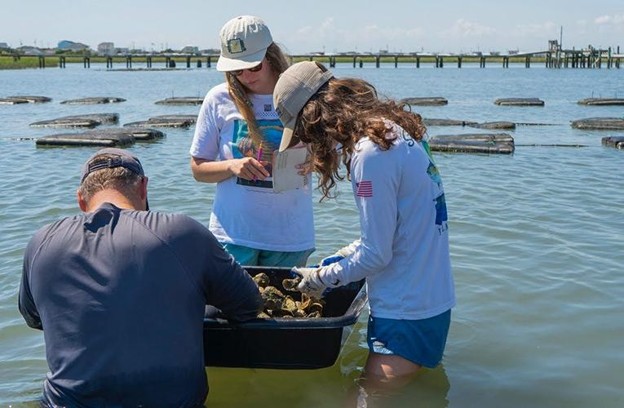
Amelia McDonald and Diandre’ Richie, MEM, masters students at the Duke University Nicholas School of the Environment , are part of a Duke University, Bass Connections team that has been exploring the effects of a changing climate on oysters.

Working at the Duke Aquafarm at the Duke University Marine Lab, the team measured how environmental stressors like warming temperatures and rising acidification impact the growth of oysters. They also tracked changes in which genes are expressed by the oysters, hoping to identify markers of resilience.

Oysters are not only a delicacy; they are also effective filterers of coastal waters. Understanding how oysters are responding to climate change will allow oyster farmers and coastal managers to make informed, collaborative decisions on the future of aquaculture and climate resilience for the N.C. coast.

Dive into oyster research on the Nicholas School of the Environment website.



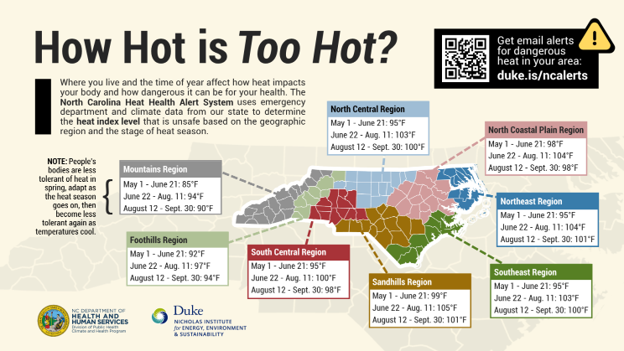
The extreme heat in our backyard and beyond has been brutal this summer. But when does heat become dangerous? And how can we be better prepared when temperatures spike?

The Heat Policy Innovation Hub at the Nicholas Institute for Energy, Environment & Sustainability has been collaborating with the state of North Carolina to build out its N.C. Heat Health Alert System.

Hub researchers, led by director Ashley Ward, helped update the system to feature temperature thresholds for alerts based on when people have historically shown up in N.C. emergency departments with heat-related issues. This has led to a more dynamic and effective system, providing more regionally- and seasonally-specific alerts.

Learn more about how heat alerts keep N.C. communities safe on the Nicholas Institute website.

Stacey Shackleton / August 11, 2026

Letter of Reference


To Whom It May Concern:

I am pleased to recommend Mario Robles, Strategic Partner at Schooley Mitchell, to businesses and nonprofit organizations seeking to reduce operating expenses, identify cost-recovery opportunities, and strengthen overall financial performance. I truly appreciate his involvement in advising our shared clients.
As a professional advisor, I regularly work with organizations focused on improving operational efficiency and maximizing the resources available to support their strategic objectives. Mario provides a valuable service by helping organizations identify savings opportunities that can easily be overlooked during the normal course of business.
Through Schooley Mitchell, Mario brings specialized expertise to the review of vendor expenses, contracts, billing practices, service levels, and pricing. His work can help organizations uncover unnecessary costs, identify billing discrepancies and potential recoveries, and determine whether they are receiving competitive value from their service providers.
For organizations operating with limited staff and competing priorities, Mario provides an additional level of expertise and financial discipline without requiring management to build that capability internally. The result is a practical approach to cost management that can produce measurable value while allowing leadership to remain focused on its core business or mission.
I am pleased to recommend Mario Robles and Schooley Mitchell as a trusted resource for organizations interested in cost reduction, cost recovery, and improved expense management. Mario combines professionalism, specialized expertise, and a genuine commitment to helping his clients achieve meaningful financial results.
Sincerely,

J. Denise Huginnie
President/CEO
Impact Focus, LLC

Click to view official document

Visit the website

Stacey Shackleton / July 27, 2026

The Fear of Public Speaking and How to Overcome It

Imagine you’re standing in front of a room full of people. Your hands are shaking, your heart is racing, and you feel like you have a lump in your throat. You go to speak and start your presentation, but nothing comes out. Unfortunately, that’s the reality for many individuals who have a fear of public speaking.

In this issue of the Pulse, we’ll discuss the fear of public speaking and ways you can overcome that fear.

Public speaking is a common fear that plagues many individuals. In fact, according to the National Library of Medicine, about 77% of the general population has a fear of public speaking.

The level of fear differs from person to person, with some only experiencing a little nervousness, while for others it can be completely debilitating. This fear can present itself through physical symptoms, such as shaking, sweating, a dry mouth, a rapid heartbeat and nausea.

However, the effects of public speaking don’t stop there. Having a fear of public speaking can have long-term effects, such as lower educational achievement and occupational impairment, as public speaking skills are valuable in higher education and the workforce, particularly at the leadership level. So, how can you overcome your fear of public speaking?

Practice

Be sure to practice your presentation ahead of time. This could look like practicing your presentation out loud by yourself or in front of a few trusted colleagues. You may also find it helpful to record yourself presenting it out loud so you can listen to it back and look for areas of improvement.

Know your material

Ensure the topic you’re presenting is one you’re comfortable with and that you know your material. If you know your material, you’re more likely to feel confident when presenting, and if you happen to forget what you practiced, you will have your knowledge to fall back on.

Join a group

If you really want to work on your public speaking skills and practicing on your own isn’t cutting it for you, consider joining a group to further develop this skill. One of the most well-known groups is Toastmasters International, a nonprofit educational organization that teaches public speaking skills through a worldwide network of clubs that meet online and in person, but there are a variety of groups you can join, as well as classes and workshops you can take.

Focus on a friendly face

If you’re presenting in front of a large group of people, try focusing on one friendly face in the crowd and pretend you’re presenting to just that individual. Presenting to a large audience can be daunting, whereas presenting to one individual can feel more conversational in nature.

Take some deep breaths before

Before you begin a presentation, take a few deep breaths. While this may seem simple, it can be very effective at calming your nervous system. As stated in a Yale School of Medicine article, titled The Power of the Breath, “Through the action of our diaphragm, slow, even breaths that originate deep within the abdomen stimulate the vagus nerve in a way that signals safety and cues our bodies and minds to relax, restore, and release chronic and unhealthy patterns.”

In conclusion…

A fear of public speaking is a very real fear that affects the majority of the population and while it can feel insurmountable, there are methods you can use to overcome it for the benefit of your own well-being and the advancement of your education and employment.

Stacey Shackleton / July 7, 2026

Could dynamic prices change your shipping bills?

If your business has been utilizing shipping services for years, you’ll know it’s been the industry norm to experience static periodic rate adjustments. These rate adjustments could make it difficult to keep on top of your expenses, as what you were paying at the beginning of the year could completely change by the end.

A new challenge business owners might face lies in how shipping providers could be changing their pricing strategies to include dynamic pricing. Major carriers across North America are gravitating towards this model, which could have a lasting impact on their clients. In this article, we take a look at what that means and what you might be able to expect.

What is dynamic pricing?

Dynamic pricing is a structure by which rates continuously change based on variables such as demand, capacity, and more. You might be familiar with this structure if you’ve ever shopped for flights, hotel rooms, taken an Uber, or even ordered something on Amazon.

What impacts dynamic pricing for small package and parcel shipping?

There are a lot of variables that can change shipping rates under a dynamic pricing model. Some of the most important factors include:

  • Real-time data on variables like:
    • Available truck capacity
    • Lane demand
    • Distance
    • Fuel costs
    • Seasonal factors
  • AI-suggested rates based on detected market patterns

What does this mean for your business shipping services?

No matter the size of your operation, dynamic pricing could potentially impact your prices significantly. At a minimum, it can make it harder to plan and budget for shipping as tightly as you might want. For businesses already struggling to meet consumer demands for fast, free shipping, this could become increasingly complicated.

Experts at Harvard Business Review warn dynamic pricing for parcel shipping “could pose serious margin risks” to some businesses.

“These evolutions will impact everyone in the supply chain, including consumers who will feel the shift through reduced free shipping, larger order minimums, slower deliveries, and higher prices. And this isn’t just an e-commerce issue. Pharma, telecom, auto parts, industrials: anyone who moves high volumes of parcels is exposed.”

With dynamic pricing potentially resulting in pricing changes as often as several times a day, it’s more imperative than ever that businesses stay on top of their shipping expenses and contracts.

Stacey Shackleton / June 18, 2026

Schooley Mitchell Helps Businesses Unlock Significant FICA Tax Savings-Salt Lake City, UT

The Federal Insurance Contributions Act (FICA) is a mandatory federal payroll tax that is deducted from each paycheck, but did you know you might be overspending on those taxes? Schooley Mitchell is now helping organizations reduce their payroll expenses through FICA tax related savings programs, and at the same time improve employee retention and benefit plans.
Through these programs, Schooley Mitchell is able to save businesses an average of $575 per employee, per year – perpetually.
Schooley Mitchell is the largest independent cost reduction consulting firm in North America, with offices from coast-to-coast in the U.S. and Canada. For additional information about Schooley Mitchell’s services, visit www.schooleymitchell.com/lmillar.

For more information about how Schooley Mitchell can help save you money on your FICA payroll taxes, contact Lisa Millar at [email protected].