
Award Recipient, Schooley Mitchell Conference
Congratulations, Adam, on winning the award for Most Facility Supplies Billings in 2025 at our 2025 conference in Punta Cana! Thank you for all your hard work!
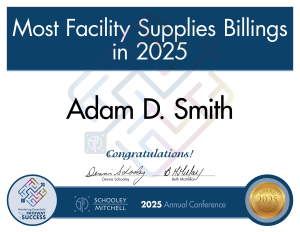
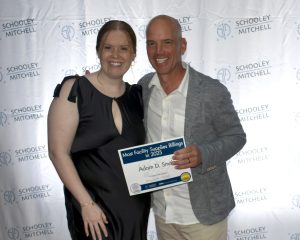
Congratulations, Adam, on winning the award for Most Facility Supplies Billings in 2025 at our 2025 conference in Punta Cana! Thank you for all your hard work!

Tariffs continue to impact the cost structure and profitability of businesses across both the U.S. and Canada. With the right strategies, you can reduce exposure, maintain competitiveness, and protect your bottom line.
Watch Schooley Mitchell’s free, value-packed webinar where we’ll break down:
Who Should Watch: Business owners, CFOs, operations managers, procurement professionals, and decision-makers concerned with cost management and global trade.

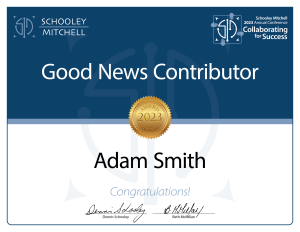
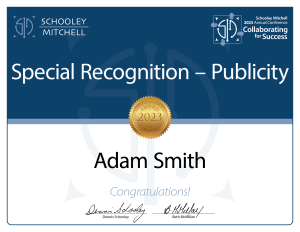
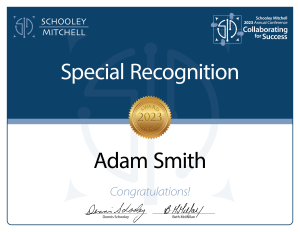
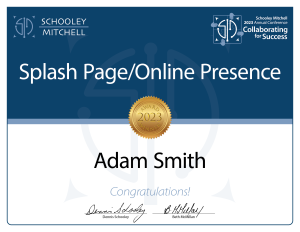
On behalf of all of Schooley Mitchell, congratulations to Adam D. Smith for winning our most EPP clients overall in 2024, most facility supplies billings in 2024, good news contributor, special recognition splash page/online presence, most EPP clients obtained in 2024, and most clients obtained in 2024 awards! Thank you for your continued hard work, Adam!
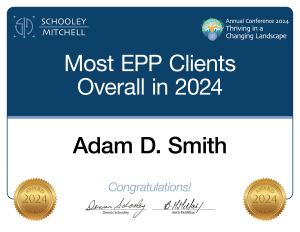
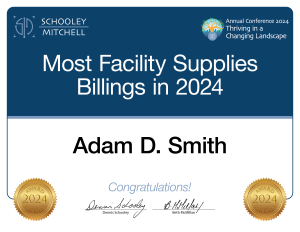
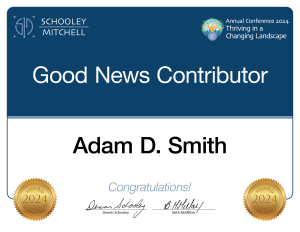
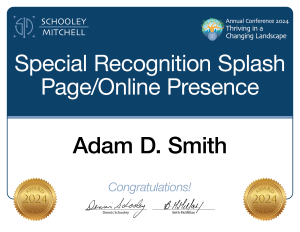
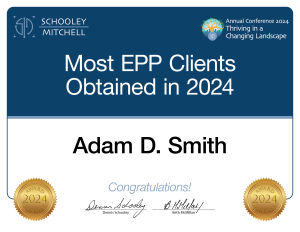
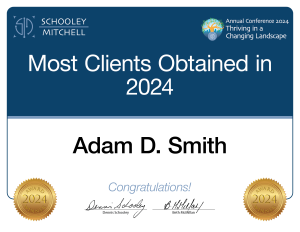

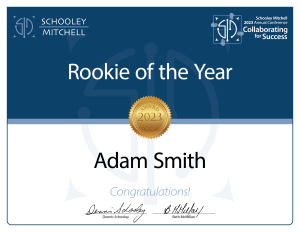
At Schooley Mitchell’s annual conference in Montego Bay, Jamaica, Adam Smith received the following awards:
Congratulations Adam and thank you for all the hard work you do!
During times of economic uncertainty, clients depend on strategic business advisors more than ever. Chances are, you’re doing all the right things; you understand your client’s business, you have optimized your suite of products and services, and you have provided excellent strategic advice across your domain of expertise. So, what else can you do to provide even more value and build stickier relationships?
The concept of the “network effect” originated in the tech space, and refers to the phenomenon where the value of a product or service increases as more people use it. Take social media, for example. Platforms like Instagram or TikTok became more valuable as more users joined and contributed content, despite more niche beginnings.
The network effect also creates economies of scale for companies with large user bases, allowing them to leverage their size to reduce costs and increase profits.
We all know it’s impossible to be all things to all people. We learned that in our Marketing 101 class! That’s why growing a diverse and highly curated personal and business network can be so valuable to your success.
The value of your network increases as you connect with more people. During a job search, the more people you know, the more likely you are to be connected to someone hiring or be provided with a good reference. As a business owner, a diverse network is more likely to help you get new customers or referrals or connect you with the right subject matter expert.
While we all serve as experts in our unique business domain, have you explored tapping into a broader set of experts that can complement your expertise and provide even more value to your clients? New connections can instantly unlock resources, insights, and revenue opportunities for your clients with just a simple introduction. I know we all tend to network with the “usual suspects” like accountants, attorneys, and financial advisors. But have you explored some more “under the radar” experts like:
As a Schooley Mitchell franchise owner, I work across almost every industry. Our cost categories apply to virtually every business. As a result, I am constantly engaged in conversations across a broad set of business topics, trends, and challenges. I am constantly looking to my network of experts and clients to help me address their diverse set of business needs.
How about we set up a call to discuss how we could collaborate and collectively harness the power of our unique personal and business networks?
Click below to open PDF
Schooley Mitchell Benefits
Schooley Mitchell Process
ICP Dental Article
Dental Success Stories
Schooley Mitchell Overview
.asmith-dental-button {
display: inline-block;
background: #7d9bc0;
color: white !important;
margin-bottom: 10px;
padding: 10px;
border-radius: 5px;
font-weight: 600;
transition: 0.25s ease-in-out;
}
.asmith-dental-button:hover {
background: #12456c;
}

 Here’s a universal truth – difficult economic times often lead to difficult choices. The choices can be even harder if you’re a business owner or manager. With your company and your staff relying on your leadership, the stress relating to financial decisions can be overwhelming.
Auto dealerships may be among the many businesses to feel the challenges posed by inflation, global supply chain issues, and consumer hesitancy. With demand running low, netting less revenue for dealerships, you may feel the pressure to reduce service offerings or even cut staff.
Rather than making a decision that could potentially hurt your business in the long run, consider another, more strategic method of reducing your costs.
The answer is simpler than you think. Instead of cutting staff or services, focus on your indirect operational expenses. Indirect expenses are costs not associated with your cost of goods sold or labor; this includes cost categories like telephone and internet, utilities, waste disposal, facility supplies, uniforms, and more.
Indirect cost procurement is the process of finding sustainable reductions to these costs; meaning they increase your bottom line without impacting your business’ operations.
Altogether, indirect costs can represent around 15% of your dealership’s annual budget. In my experience, many business owners either don’t have the time to assess these expenses or don’t have the knowledge or tools to look for ways to reduce them.
My business, Schooley Mitchell, has been working with businesses and organizations across North America for over twenty years, reducing their operational expenses across thirteen different cost categories. We’ve found that many businesses don’t even know they’re overpaying vendors. Our indirect cost procurement process helps reduce these expenses by an average of 28% – which can amount to some significant savings.
For auto dealerships, one of the expenses we find needs optimizing quite frequently is their telecom and waste disposal spend. Recently, we helped deliver roughly 39% in savings for one business’ waste fees, and for another, achieved annual savings of $10,000 in waste disposal and telecom fees.
So you want to begin cutting indirect costs, but where do you start? Here is my five-step recommendation for indirect cost procurement that any dealership can follow:
Admittedly, these five steps can be time consuming and feel a bit daunting. However, 15% or more of your dealership’s annual budget is no small thing, and with an ever-changing economic environment, that piece of the pie could go from important to critical in the blink of an eye.
Your time is valuable, and so is your budget. If you don’t want to choose between cutting costs and doing the work you love, I’d be happy to arrange a time to talk about how Schooley Mitchell can do a risk-free analysis of your indirect costs. The best part? Our fees are self-funded from a portion of the savings we find – meaning, if we don’t find savings, our work comes at no cost.
Please a time to talk at: https://www.schooleymitchell.com/asmith/#Contact